
Sacrament of Healing
For many people, there is still a hesitation about calling a priest for the Anointing of the Sick—especially for those who grew up knowing it as “Extreme Unction.” Since the Second Vatican Council, the Church has renewed both the teaching and the pastoral practice of this sacrament.
It is neither necessary nor recommended to wait until someone is near death before seeking anointing. In fact, the Church encourages the faithful to request the sacrament whenever they are seriously ill, preparing for surgery, or in need of spiritual or emotional healing. Through this sacrament, Christ offers spiritual strength, peace, and courage, along with the forgiveness of sins, to those who are suffering.
Individual and Communal
“Anointing of the Sick” can be performed on an individual basis according to the person’s needs, or offered on a communal basis.
A communal celebration of the Anointing of the Sick is offered on the third Sunday of every month, immediately following the 1:00 PM Mass in the Chapel.
During this liturgy, the priest invites all forward who are experiencing illness, preparing for surgery, dealing with the effects of aging, in need of physical, emotional, or spiritual healing; are welcome to receive this sacrament. Family members and caregivers are also encouraged to attend and pray with those being anointed.
In the event of a Sacramental emergency, please call the parish office. (after hours, please follow the voicemail instructions; it will connect you to the answering service).
Requesting a Home or Hospital / Hospice Visit 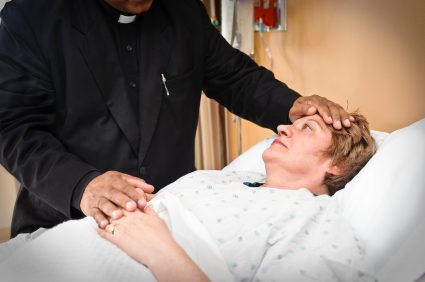
- Please leave the name and phone # of the sick person OR name and phone number of the caller and their relationship to the person requesting the visit. (family member, friend, chaplain)
- Is the caller or the sick person a parishioner of Saint Brigid?
- The person receiving the sacrament must approve of this request.
- Location of the Sick ( address, room number, any restricted hours?…)
- Purpose of the visit (Anointing, Communion, Confession, consultation?)
In the Church’s Sacrament of Anointing of the Sick, through the ministry of the priest, it is Jesus who touches the sick to heal them from sin – and sometimes even from physical ailment. His cures were signs of the arrival of the Kingdom of God. The core message of his healing tells us of his plan to conquer sin and death by his dying and rising.
The Rite of Anointing tells us there is no need to wait until a person is at the point of death to receive the Sacrament. A careful judgment about the serious nature of the illness is sufficient.
When the Sacrament of Anointing of the Sick is given, the hoped-for effect is that, if it be God’s will, the person be physically healed of illness. But even if there is no physical healing, the primary effect of the Sacrament is a spiritual healing by which the sick person receives the Holy Spirit’s gift of peace and courage to deal with the difficulties that accompany serious illness or the frailty of old age.
~from the United States Catholic Catechism for Adults
Sacrament of Anointing provides a special grace
- The uniting of the sick person to the passion of Christ, for his own good and that of the whole Church.
- The strengthening, peace, and courage to endure in a Christian manner the sufferings of illness or old age
- The forgiveness of sins, if the sick person was not able to obtain it through the sacrament of Penance
- The restoration of health, if it is conducive to the salvation of his soul
- The preparation for passing over to eternal life
Catechism of Catholic Church 1532
The special graces offered in the Sacrament of Anointing (oursundayvisitor.com)